Green Activism in Post-Socialist Europe and the Former Soviet Union by Adam Fagan & Joann Carmin
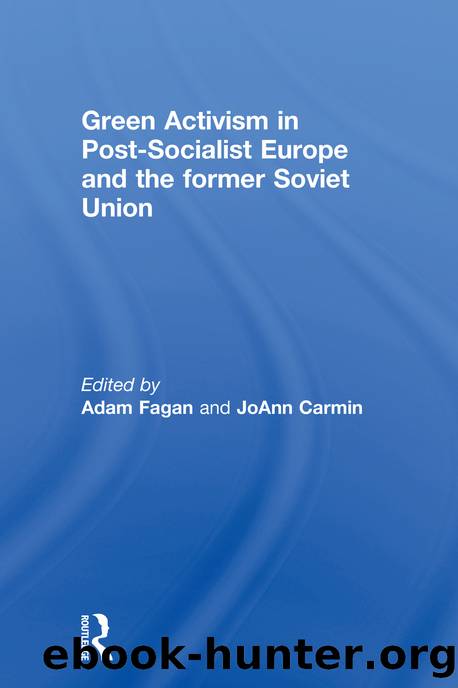
Author:Adam Fagan & Joann Carmin [Fagan, Adam & Carmin, Joann]
Language: eng
Format: epub
Tags: Political Science, Political Ideologies, Democracy, Public Policy, Environmental Policy
ISBN: 9780415668545
Google: PrzQpwAACAAJ
Goodreads: 13714977
Publisher: Routledge
Published: 2011-01-15T09:45:38+00:00
In many cases, regional elites have benefited from illegal logging and are complicit in over-harvesting. Only the threat of stronger state oversight can change these harmful practices, demonstrating that even significant adoption of transnational rhetoric and institutions cannot compensate for weak domestic governance.
Transnationalism: benefits and challenges
As these cases make clear, transnationalism can be a useful tool for Russian environmentalists. Many contemporary environmental issues are transnational by nature - either because their effects are transboundary or because environmental degradation emerges in relationship to the incentives of the international economy. Russian political elites, including Vladimir Putin, have appeared to be more concerned about Russia's reputation and stature within international community than dissatisfaction at home where there is no viable political opposition. Although the cause and effect relationships are difficult to 'prove', transnational pressure appears to have contributed to certain high profile decisions, such as President Putin's decision to relocate the Transneft pipeline planned to pass near Lake Baikal and Russia's ratification of the Kyoto protocol. These decisions were taken in ways that guaranteed international attention and, in some cases, created the possibility of other benefits.
The varying levels of success achieved by these campaigns - greater in forest certification, mixed in climate change, and limited in the energy sector - suggest that rhetorical change is not necessarily followed by meaningful institutional change. Yet, transnational linkages are most powerful when they improve domestic institutions of environmental oversight or policy-making in the longer term. Institutional change appears most likely when environmental and economic incentives coincide. On the issues of climate change and forest certification, the opportunity exists for state and private actors become engaged in ongoing processes that change their incentives in order to produce better environmental outcomes. In the case of climate change, transnational attention shifted away from Russia in the wake of its ratification of the Kyoto protocol, and the country has been slow to develop a domestic climate change policy. The opportunity still exists for Russian firms to participate in flexible mechanisms like joint implementation that could lead to a reduction in greenhouse gas emissions; concerns about economic modernisation may lead to more investment in energy efficiency. The forestry sector seems to hold greater promise for changing environmental governance. The creation of Russian programmes rivalling the FSC certification process, each offering its own rubric for evaluating firms, is simultaneously evidence of domestic actors desire to resist or alter the transnational campaign, and also of how the domestic conversation can be changed by a transnational campaign.
These cases also illustrate the poor performance of Russia's environmental regulation and laws that technically allow for NGO participation in policymaking. Time after time, environmentalists have found themselves frustrated in their efforts to use the state's policy-making and legal apparatus. Instead, they target the highest political authority, frequently then President and now Prime Minister Putin. Activists recognise this problem, a practice akin to 'appealing to the tsar' in imperial Russia which fails to generate the kind of systemic change that would ensure better environmental governance in the future.
Download
This site does not store any files on its server. We only index and link to content provided by other sites. Please contact the content providers to delete copyright contents if any and email us, we'll remove relevant links or contents immediately.
| Anthropology | Archaeology |
| Philosophy | Politics & Government |
| Social Sciences | Sociology |
| Women's Studies |
The Secret History by Donna Tartt(19089)
The Social Justice Warrior Handbook by Lisa De Pasquale(12190)
Thirteen Reasons Why by Jay Asher(8910)
This Is How You Lose Her by Junot Diaz(6887)
Weapons of Math Destruction by Cathy O'Neil(6280)
Zero to One by Peter Thiel(5802)
Beartown by Fredrik Backman(5754)
The Myth of the Strong Leader by Archie Brown(5508)
The Fire Next Time by James Baldwin(5446)
How Democracies Die by Steven Levitsky & Daniel Ziblatt(5219)
Promise Me, Dad by Joe Biden(5153)
Stone's Rules by Roger Stone(5088)
A Higher Loyalty: Truth, Lies, and Leadership by James Comey(4964)
100 Deadly Skills by Clint Emerson(4925)
Rise and Kill First by Ronen Bergman(4789)
Secrecy World by Jake Bernstein(4753)
The David Icke Guide to the Global Conspiracy (and how to end it) by David Icke(4720)
The Farm by Tom Rob Smith(4513)
The Doomsday Machine by Daniel Ellsberg(4490)
